


In the discipline of homeopathy, the accurate selection of a simillimum—the remedy most closely matching the totality of a patient’s symptoms—has historically relied on the interpretive skill of a practitioner and a static repertory. With the emergence of Symphysis, an AI-driven therapeutic platform, this process is revolutionized through a system known as Adaptive Remedy Matching (ARM): a continuously evolving algorithmic framework that mimics the dynamic clinical reasoning of seasoned homeopaths while integrating large-scale, real-time symptom data.
🧠 Understanding the Foundation: Beyond Repertorization
Traditional homeopathic case analysis employs repertorization—categorizing and cross-referencing symptoms to identify potential remedies. While foundational, this method is inherently static, lacks pattern adaptability, and does not account for longitudinal or individualized response patterns.
Adaptive Remedy Matching, by contrast, employs a multi-layered inferential engine that integrates:
Potency curve modeling, drawing from Kentian, Hahnemannian, and contemporary posology theories
Natural Language Processing (NLP) to extract qualitative symptom language
Miasmatic analysis to assess chronic disease diatheses (e.g., psoric, syphilitic, sycotic profiles)
Constitutional profiling using temperament, modality preference, and biometric patterns
Bayesian updating for remedy probability weighting based on real-time feedback
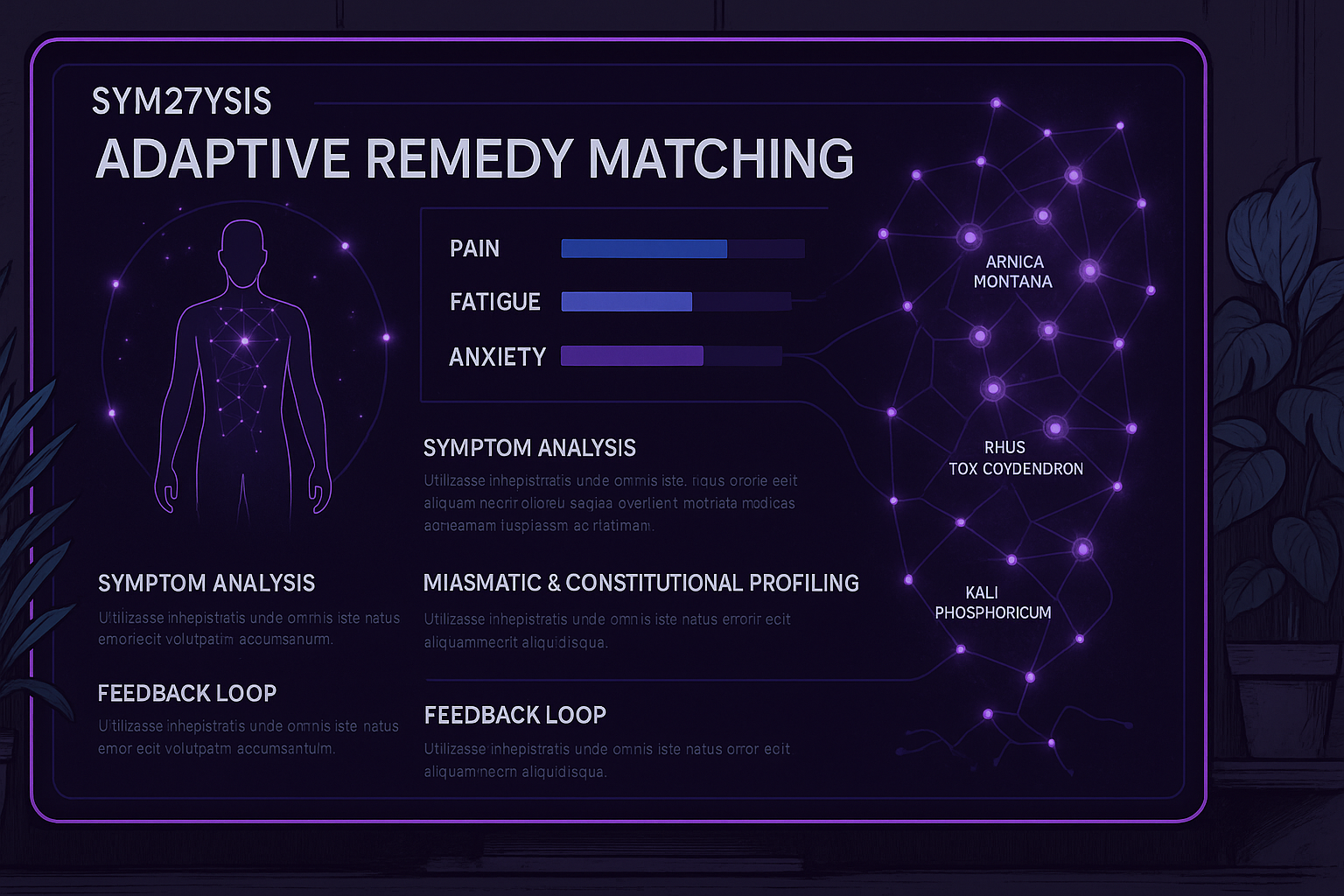
The Adaptive Loop Explained
Feedback Loop Integration
After administration and monitoring via Intelligent Therapeutic Feedback Loops (ITFLs), real-world efficacy is measured using:
- Symptom trajectory vectors
- Modal shift probabilities
- Aggravation-response timelines
- Healing crises & secondary symptoms
Initial Input Ingestion
Patient data is collected via conversational interface or structured symptom input, where NLP algorithms extract and assign weighted rubrics based on standardized materia medica databases (Boericke, Clarke, Allen, and modern expansions).
Remedy Vectorization & Scoring
Using vector embeddings, each remedy is translated into a multi-dimensional matrix of attributes (symptoms, modalities, mental states, affinities, potencies). Cosine similarity functions determine relational closeness between patient data and remedy profiles.
Dynamic Remedy Stack Generation
A ranked “remedy stack” is created, where:
Top 3–5 candidates are presented
Remedies are scored using weighted symptomatic correlation and miasmatic alignment
AI considers constitutional type, disease phase (acute vs. chronic), and remedy depth
Advanced Matching Modules
- Miasmatic Matrix Layer:
Analyzes chronic predispositions and hereditary trends to assess whether an anti-miasmatic remedy is required to remove therapeutic blockages. - Psycho-emotional Constellation Parser:
Leverages affective computing and sentiment analysis to integrate mental/emotional rubrics—crucial in constitutional remedy selection. - Genotypic-Phenotypic Overlay (Future Module):
Integration of user-uploaded genomic data (when available) will enable prediction of remedy responsiveness based on polymorphic detox pathways, susceptibility markers, and epigenetic expression.
Why Adaptive Remedy Matching Matters
- Clinical Precision: ARM moves beyond static rule-based systems, offering personalized, evidence-responsive remedy protocols.
- Longitudinal Intelligence: Each user’s health trajectory informs remedy matching—making Symphysis smarter with every interaction.
- Potency & Dosing Optimization: Adaptive logic allows nuanced recommendations (e.g., ascending LM potencies vs. centesimal scale based on patient reactivity).
- Data-Driven Homeopathy: Finally bridges classical homeopathy with the rigor of computational medicine.
Adaptive Remedy Matching represents a quantum leap for homeopathy in the digital age. Through continuous refinement, deep data mining, and bio-intelligent modeling, Symphysis delivers what the classical systems could only dream of—a therapeutic intelligence that evolves with the patient, not just the protocol.
This is not the future of homeopathy—it is its rebirth, through code, consciousness, and care.